Showing posts with label Vietnamese Ao Dai. Show all posts

Thursday, July 1, 2010

Ao Dai for men


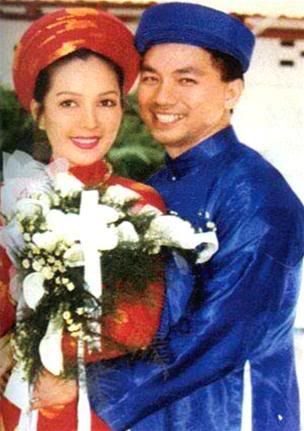
  Do you ever see Ao Dai for men ? Of course men also have “Ao Dai” They look like ao dai for women but something differences such as they are bigger and shorter than ao dai’s women. In the past only rich men wear them because of it expensive and gorgeous but now everybody can wear them and usually in public every Vietnamese New Year and for wedding.Especially in Wedding have a question about What color looks good for male Ao Dai that will match with women Ao Dai?

        I think blue is for straight men its look good for guy but can wear gold or red color and please avoid tan or gray color because it makes you look old.

Wednesday, June 30, 2010

Most expensive wedding dress in Vietnam: $117,000

$117,000 wedding dress is most expensive in Vietnam
The wedding gown is made of white silk and satin, and laviously highlighted with a big gemstone-made flower. The wedding dress flower consists of 22 big rubies and eight big diamonds. The pistil is a huge water drop-shaped ruby, symbolising love.

The gown was presented a certificate for being the most expensive bridal gown in Vietnam from the Vietnam Record Book Centre on the day of introduction.

Hours and hours of handwork make the most expensive wedding dress
The most expensive wedding dress in Vietnam took 40 days of hand sewing, idea creation, choosing and processing gems and 24 hours alone for attaching the gemstones.

www.examiner.com

Saturday, June 26, 2010

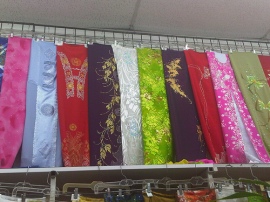
How to buy fabric for ao dai

Check the materials carefully for holes, cuts, rips, etc. before you ask them to cut. Once, we asked to check the material before the woman cut the fabric and they all said we were worrying for nothing; however, upon close inspection, there was a thumb-size hole in the yard that they cut for us so they had to cut us another yard.

There are always a lot of customers and not enough sales associates so you have to hunt them down to get them to cut the fabric for you.

After selecting the fabric that you like (such as for the pants of the ao dai), ask them to recommend alternative materials. They might be able to recommend something in stock that is similar in quality but more reasonably priced.

Saturday, June 12, 2010

History of Vietnamese wedding dress

The Vietnamese wedding dress history can be traced back to the early 1700’s, when Vietnamese clothing was greatly influenced by the imperial Chinese garment during the Qing dynasty called the qipao.

Compared to the qipao, the áo dài is a bit looser, with a wide and flowing skirt. Another distinct difference between the two garments includes the length of the áo dài’s slits. Unlike the qipao, the áo dài had slits that extended to the wearer’s waist, showing a part of the wearer’s sides.

Since its inception, the áo dài has had numerous alterations and modifications designed to make the outfit more appealing and practical for the succeeding Vietnamese generations. Today, shorter, more revealing and more form-fitting versions of the áo dài are available to Vietnamese women.

Tuesday, March 9, 2010

Vietnamese and Western Wedding

Most Vietnamese wedding takes place in the autumn and winter, when the weather is cooler and famers have less fieldwork. Europeans, meanwhile, tend to marry in the summer. What most Westerners fail to realize is that ancient superstitions influence their wedding dates. Accoding to an old rhyme, couples marrying in June (the most popular month for Western weddings) may look forward to”one long honeymoon”. This belief goes back 2000 years, since the sixth month was named after Juno, the Roman goddess of marriage. May, meanwhile, was deemed disastrous for marriage, as the Romans presented offerings to the dead at this time.

Many Vietnamese families turn to astrologers to help determine the bride and groom’s compatibility and to choose an auspicious wedding day. For a Vietnamese woman, getting married at the age of 22, 23, 26, or 28 is considered unlucky.
In both Vietnam and the West, getting married traditionally involved two steps: the engagement and the wedding.

Tuesday, October 6, 2009

Where to buy vietnamese fabrics


Where to buy Vietnamese Clothing? The obvious answer is Viet Nam, but since most of us cannot afford a trip to Saigon we need to find a closer source for traditional Vietnamese clothing.

FIRST - A LITTLE INFORMATION

The traditional Vietnamese Costume for a woman or man is an Ao Dai. The Ao Dai (pronounced ‘oh yai’) for a woman consists of a long flowing dress with a split panel skirt and a pair of loose fitting pants. The Ao Dai dress has a form-fitting bodice (top) with long sleeves. Attached to the bodice is a long skirt, which is made up of 4 panels. The panels attach the bodice at the waist (2 panels in front, two in back) and the length can be anywhere from below the knee to the floor. The panels flow around the legs of the wearer in an elegant swirl. The neckline can either be a boat neck (a simple curve below the neck) or a stiff Mandarin collar. The bodice of the Ao Dai can be constructed to button in a variety of ways - down the front, on the side, or the more traditional way, buttoning from the side of the neck diagonally across to just above the breast and under the arm.


The Ao Dai is form fitting for the woman. Anyone wanting an Ao Dai would go to a seamstress to be properly measured. The dress is be made especially for the individual. The Ao Dai is figure flattering and very beautiful on the wearer.


The traditional fabric used to make the Ao Dai is cotton or silk. Cotton and silk are very cool and comfortable fabrics and are perfect for the hot, humid jungle environment of Viet Nam.


Traditionally, the color of the Ao Dai for a woman denotes her age or marital status. White means the girl is young and unmarried - early and late teens. Pastel colors are for unmarried woman who are older - mid-late 20's. The deeper colors such as red and blue are for married women.

The Ao Dai for men is shorter and does not have the split panels. The Ao Dai top for men ends around the knees. The collar type is the Mandarin collar and the colors are dark. The Ao Dai for men are not form fitting as it is for the woman.

WHERE TO BUY AN AO DAI

Because the Ao Dai are custom made you will not likely find it "off-the-rack" in any store. You will have to find a Vietnamese seamstress. This may take some searching on your part. Most Vietnamese coming to the U.S. (or any Western country) have settled in the larger cities. In the U.S., Chicago, Los Angeles, Austin, and San Francisco have large Vietnamese populations.

Look in the phone book for Vietnamese businesses, especially grocery stores and video stores. You should be able to find the name of a good seamstress from them. These merchants would also be able to give you the best source for Vietnamese silk fabric.

There are often Vietnamese associations, who can be contacted for information. For example, in Chicago there is the Vietnamese Association of Illinois.

There are very few companies for purchasing Ao Dai online. Ordering the Ao Dai online is not much different than ordering other clothing online, with the exception of measurements. You will be required to enter your measurements on the website instead of a standard size to ensure you get the best fit possible. The site will display the different styles and fabric choices available. The cost is quite reasonable – between $80.00-$150.00.

Auction sites sometimes have Ao Dai listed. This will not be the elegant, form-fitting Ao Dai traditionally worn.

MAKE IT YOURSELF

There are patterns available for the Ao Dai from vintage and ethnic pattern companies and cost around $16.00. The patterns are sold at sewing supply stores and online. The pattern is relatively easy to use and the dress is not difficult to make. Simply use the search term "ao dai sewing pattern" in any search engine and you will find online sources for the pattern.

If you do not sew, a local seamstress can make it for you for under $100.00. A medium Ao Dai dress with the pants will take 6 yards of fabric. The fabric for the pattern does not have to be Vietnamese silk if you do not want to spend a lot for the dress. A simple cotton or inexpensive silk can be used from your local fabric store. The beauty of the Ao Dai is in the design and fit. Any lightweight fabric will produce an attractive dress.

Whether you have it custom-made or purchase it on the Internet, the Ao Dai is a beautiful addition to any wardrobe.

from http://www.essortment.com/lifestyle/wheretobuyvie_sapf.htm
Friday, September 25, 2009

History Vietnamese Traditional wedding clothes

Ao Dai Is Graceful National Dress of Vietnamese Women, My Tho, Tien Giang, Vietnam Photographic Poster Print by Stu Smucker, 24x32
While traditional wedding clothes of Vietnam have always been very diverse depending on the era and occasion, it is known that after the Nguyen dynasty, women began to wear elaborate Áo dài for their weddings which were modelled on the Áo mệnh phụ (royal Áo dài) of Nguyen dynasty court ladies. The style of the Nguyen dynasty has remained popular and is still used for modern weddings. The difference of the Áo mệnh phụ from the typical Áo dài is the elaborateness of its design (usually embroidered with imperial symbols such as the phoenix) and the extravagant outer cloak. With this gown which is preferably in red or pink, the bride usually wears a Khăn đống headdress. The groom wears a simpler male equivalent, often in blue.
Previous to the Nguyen dynasty, it is likely that women simply wore fancy, elaborate versions of Áo tứ thân.

Thursday, September 24, 2009

Traditional Dress in a Changing World

In Viet Nam, the ao dai is the traditional dress for women. Developed from Chinese court clothing in the 1930s, this style of clothing went out of fashion in the north in 1954 and in the south in 1975. Recently, however, it has made a comeback and is regaining popularity in the south among schoolgirls and office workers, and is being worn at formal functions. An indication of social standing, the ao dai is worn by women who work as shop assistants or who have a higher social status, while manual workers typically wear a loose top and baggy pants called an ao ba ba.

The ao dai is considered to be an elegant, yet demure, garment. Traditionally, long, wide- legged trousers are worn under a high-necked, long-sleeved, fitted tunic with slits along each side. The outfit’s pants reach to the soles of the feet, often trailing along the ground. Over time, the dress tunic has evolved, keeping with fashion trends, and has grown shorter and shorter until it now falls just below the knees. The ao dai can also be identified by its mandarin-style or boat-neck collar. Young girls wear only pastel colored or white garments while married women wear either dark or bright tunics over black or white trousers.

Historically, Vietnamese men dressed in mandarin style suits. With a tunic shorter and fuller than the ao dai, the suit’s color was traditionally determined by the man’s class and social rank. For example, a purple suit denoted a high rank while blue denoted a low rank. Status was also indicated through a variety of embroidered symbols. Today the mandarin suit is rarely worn except for in traditional dance or music performances.

In general, Vietnamese people dress conservatively. Although some young women wear more close-fitting, Western-style clothing, it is considered inappropriate to wear revealing clothes during the day. One Westerner teaching English in Viet Nam was advised to tuck her shirt into her trousers if she expected respect from her students. It is considered inappropriate for educated people to wear their shirts untucked.

Wednesday, September 23, 2009

Ao Dai Wedding Styles 1

AoDai Weddind Styles 1


Vietnamese traditional dress showcased in Thailand

Vietnamese traditional dress showcased in Thailand


A performance of Vietnamese traditional long dress (ao dai) was organised on December 3 in Ayutthaya, the former capital city of Thailand, attracting a lot of Thai and regional audiences.
This is under the framework of the first ASEAN Arts and Crafts Festival (AACF) which was held from November 29 to December 3.


During around one hour, six collections of Vietnamese traditional long dresses and Vietnamese traditional brassieres through the performance of 14 models of the Kalawin Fashion House of Thailand attracted the audiences.


Audiences highly appreciated the collections whose designs and harmony of colours highlighted the value of the tradition and modernity of Vietnam.


Designs by Lan Huong performed in Thailand.


Designer Lan Huong said she herself chose high quality material such as silk and taffeta from provinces of Ha Tay, Lam Dong and Da Nang for her products. Therefore, her dresses are combined with features of famous silk and embroidery handicraft villages in Vietnam. This aims to honour the beauty of women and the cultural and art values of Vietnam.

Tuesday, September 22, 2009

AoDai Wedding Styles 2


Vietnamese in Traditional Red


East Asians are ringing in the Lunar New Year in a big way. And many Asian brides select this auspicious time of the year to get married.


Vietnamese people celebrate the lunar year in pretty much the exact same manner as the Chinese people do. There are many similarities when it comes to wedding traditions as well.
For example, Chinese brides, both modern and classic, typically change outfits three or more times on their wedding night.


Vietnamese brides do the same. The bride, in fact, may wear four to five dresses. And the groom changes outfits too!
The traditional Vietnamese wedding dress, known as Ao Dai, is often fashioned in brilliant red and yellow.


It is embellished by intricate embroidery of golden yellow motifs that denote marital bliss and prosperity. It is interesting to note that the national dress for both women and men is Ao Dai, which is worn both for festive wedding occasions and every day use.


The term Ao Dai literally means "long dress" and it is made up of over four layers of silky overlapping fabric, which are pleated over loose-fitting trousers made from the same fabric. It is believed that the more the layers, the more wealth of the wearer. Since this form of dress in a way denotes the financial status of the person who is wearing it, some well-heeled people wear multiple Ao Dai to show off their riches!


Ao Dai has a snug fitting bodice with long slits that run down from the waist and diagonal seams that extend from the neckline to the underarm to accentuate the natural curves of the hourglass figurines.


The brides also opt for an outer robe over the Ao dai for a classic appearance. There are many necklines to opt for such as mandarin collars to complete the picture of this stunning wedding gown.


To redefine conventions, go for the bold low neck style. That will grab attention as you pace down the aisle with your partner hand in hand!


Wedding gowns are almost always red in color though brilliant pink is also used at times.
The exceptional gold trimmings add dollops of exuberance to the wedding garb. Normally the trimmings of traditional motifs, Chinese alphabets or the name of the couple are painted or stitched along the back, cuff and collar.


The bride adorns her head with the typical cone shaped hat made from dried woven leaves or the more popular saucer shaped khanh vanh. The bride and the groom change their gowns at least three times during the wedding.


The wedding trousseau can includes a western wedding gown with white tuxedo, to the Ao Dai and the evening gown with black tuxedo.


These days, Ao Dai has attained a cult status of an elegant stately costume that accentuates all types of feminine frames. It is a popular wedding option among westerners as well, to infuse an Asian a theme into their weddings.

Photo courtesy of Quynh

Monday, September 21, 2009

Sharing a poem on Ao Dai


Dear Author,


As a Vietnamese I must be grateful to you and to your article on the Ao Dai of Vietnam.

I would like to share with you a poem on the Ao Dai Vietnam, firstly in Vietnamese then later in English. If Ihave a chance to meet you or to serve you as a tour guide, I will recite the poem in Vietnamese.

Ao dai doi canh tien bay
La hon dan toc, huong say cua doi
Don so hai manh tuyet voi
Than sau, vat truoc thanh loi nuoc non

Ao Dai, the two wings of a fairy
The spirit of the Vietnamese people and the perfume of life.
Very simple with two wonderful flaps
One in the front and the other in the back
And it makes beautiful words of the country

Hope you like the poem.

Vietnamese Wedding Picture